5 Common Singing Mistakes Women Make
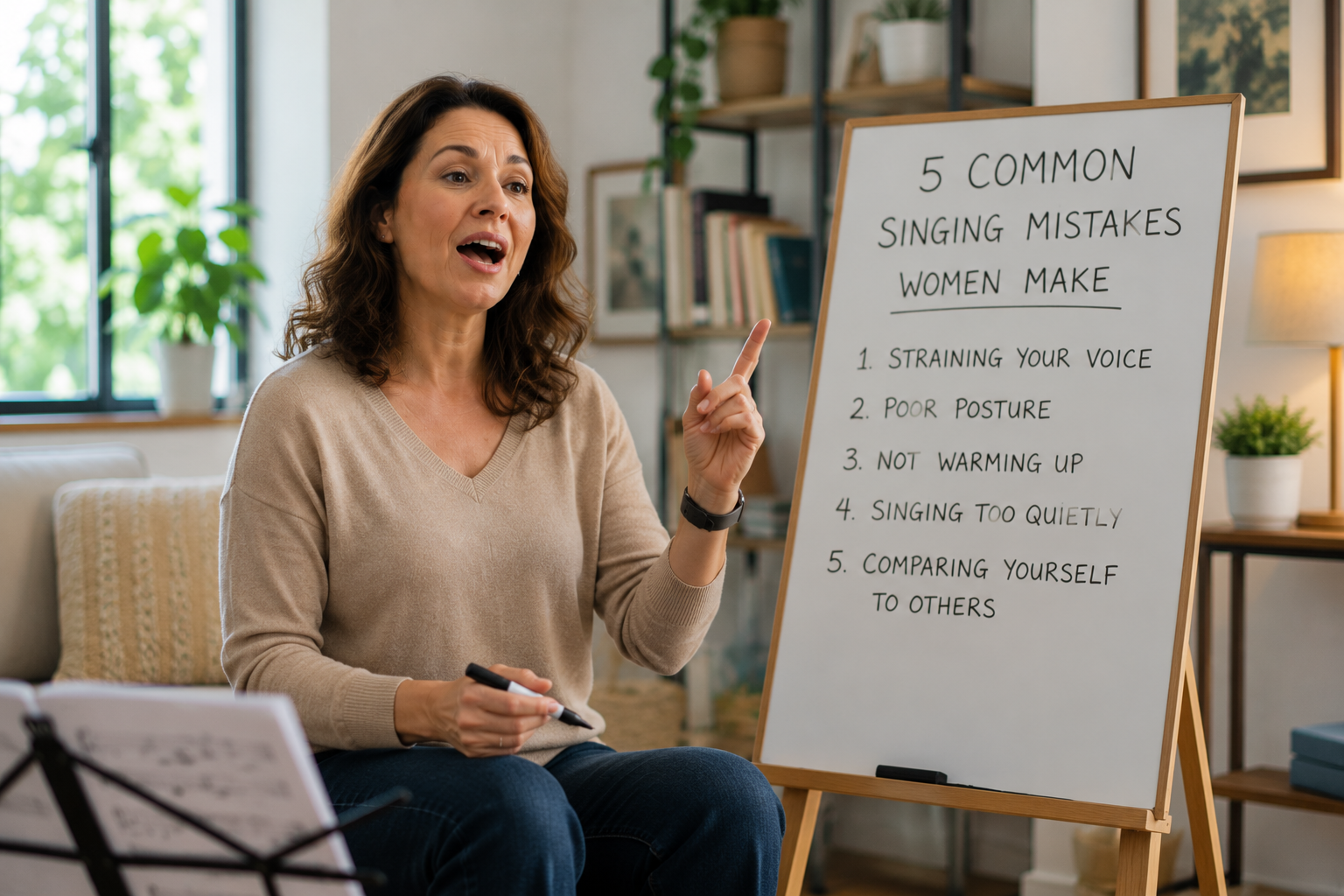
If you used to sing and you’re finding your way back to it now, I want to start with something reassuring: the wobbles, the cracks, the moments that don’t sound how you remembered are not signs that your voice is gone. They are signs that your voice is out of practice, which is a completely different thing. After years of coaching women returning to singing in their 40s, 50s, and 60s, I’ve noticed the same handful of habits getting in the way again and again. The good news is that every one of them is fixable. Here are the five I see most often, and what to do instead.
Mistake 1: Expecting your voice to pick up right where it left off
This is the big one, and it’s emotional as much as technical. You remember how you sounded at twenty-five, and when something different comes out now, it’s easy to decide you’ve simply lost it. But a voice that hasn’t been used in years is like any other part of the body that’s been resting: the strength and flexibility are still there, just waiting to be woken up.
Do this instead: Meet your voice where it is today, not where it was. Give yourself a few low-pressure weeks of gentle, consistent practice before you judge anything. Range, control, and tone all come back, but they come back to women who keep showing up, not to women who quit on day three.
Mistake 2: Skipping the warm-up
When time is tight, the warm-up is the first thing to go. You want to get to the song, so you launch straight in. The problem is that cold vocal folds are stiff and unresponsive, and asking them to do big, expressive things without preparation is how you end up hoarse, flat, or strained.
Do this instead: Treat five minutes of gentle humming and light sirens as non-negotiable. A proper warm-up isn’t a delay before the real singing; it is part of the singing. It only takes a few minutes, and it’s the single highest-return habit you can build.
Mistake 3: Pushing for volume from the throat
So many women equate singing better with singing louder, and they try to manufacture that power by squeezing and pushing from the throat. It feels like effort, so it feels productive, but it’s the fastest route to tension, strain, and that tired, scratchy feeling afterward.
Do this instead: Let volume come from breath, not force. When you support a note with a steady stream of air from low in your body, your throat can stay relaxed and open. Think more air, not more push. A free, supported voice will always carry further than a forced one, and it won’t leave you sore.
Mistake 4: Forgetting to actually breathe
It sounds almost too simple, but shallow, high chest breathing is behind a huge number of the problems women bring to me. When you breathe only into the top of your chest, you run out of air halfway through a phrase, your pitch sags, and your shoulders creep up toward your ears. The voice has nothing to ride on.
Do this instead: Practice breathing low and wide, feeling your ribs and belly expand rather than your shoulders rise. Take a few slow breaths before you sing, a hand on your stomach, making sure it moves out as you inhale. Breath is the engine of singing, and when the breath is steady, almost everything else gets easier.
Mistake 5: Being far too hard on yourself
This isn’t a technical mistake, but it might be the most damaging one of all. A voice crack, a missed note, a recording that makes you cringe, and the inner critic pounces. Many women stop singing altogether not because they can’t improve, but because that harsh self-talk makes practice feel awful. Singing is vulnerable, and rebuilding a skill in midlife takes a particular kind of courage.
Do this instead: Talk to yourself the way you’d talk to a friend who was brave enough to try something new. Cracks and rough notes aren’t failure; they’re the sound of a voice rebuilding. Track small wins, celebrate the days you showed up, and let practice be a place of curiosity instead of judgment.
You’re closer than you think
If you recognized yourself in a few of these, please don’t read that as bad news. Every one of these mistakes is a habit, and habits can be swapped for better ones a few minutes at a time. The women who get their voices back aren’t the ones who were naturally gifted or who never made mistakes; they’re the ones who kept practicing gently and consistently, and who were kind to themselves along the way.
That’s exactly why I built Vocal Refresh, the five-minute daily app for women coming back to singing after years away. It walks you through proper warm-ups, helps you build breath and confidence without strain, and lets you track how far your voice has come. If you’d like a structured, judgment-free way back to singing, come join the waitlist. Your voice is still in there, and it’s ready when you are.