5 Best Breath-Control Exercises for Singing Moms
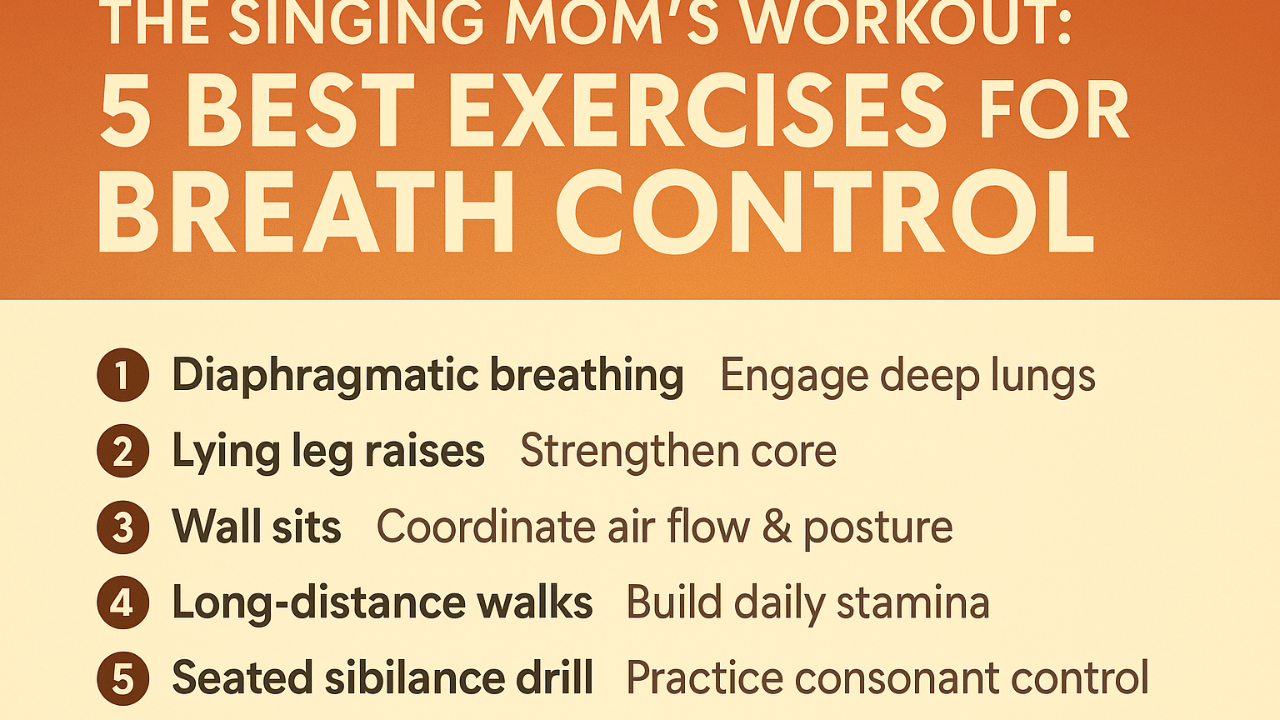
If you’ve ever run out of air halfway through a phrase—or felt like your breath drops out under pressure—you’re not alone. Breath control is one of the first skills to fade when you take time off singing… but it’s also one of the fastest to rebuild.
These 5 singer-friendly exercises target the three keys of vocal breathwork:
💨 Deep lung expansion
🏋️♀️ Core + posture coordination
🧠 Mental control of airflow and onset
Need help just finding your breath? Start with our Breath Control Basics first.
1. Diaphragmatic Breathing (3–5 min/day)
How to do it:
Lie flat with a book on your belly. Inhale through the nose for 4 counts, feel the book rise. Hold 1 count, then hiss out for 8. Work up to 12.
Why it works:
Activates the lower ribs, where true breath support begins—not the shoulders.
2. Lying Leg Raises (2 sets of 10)
How to do it:
Lie flat, hands under hips. Inhale, then slowly raise both legs to 90°, exhale on a hiss as you lower them back down. Keep your back flat to the floor.
Why it works:
Strengthens the transverse abdominals that support sustained phrases.
3. Wall Sits + Hiss (2 rounds of 30 sec)
How to do it:
Slide down a wall into a 90° seated squat. Inhale through the nose, then exhale on a long, even “sss.” Keep your ribs expanded and shoulders relaxed.
Why it works:
Combines posture, core stability, and airflow metering—just like real singing.
4. Long-Distance Walking
How to do it:
Walk briskly for 15–30 minutes daily, focusing on nasal inhalation and consistent airflow on exhale. Try counting steps between inhales.
Why it works:
Builds cardio stamina and baseline breath capacity without pushing the voice.
5. Seated Sibilance Drill (“Zss-Fff-Sss”)
How to do it:
Sit tall and cycle through these sharp consonants on one long breath:zss-fff-sss… Repeat for 30–60 sec, 2–3 times.
Why it works:
Trains consonant control and air efficiency for phrase shaping in songs.
Bonus Tip: Stack with Your Warm-Up
These drills aren’t warm-ups themselves—but they make your warm-up 10× more effective. Try this flow:
3 min diaphragmatic breathing
Vocal warm-up (use this guide)
Add 1–2 breath drills from above
Sing 🎶
FAQ
Frequently Asked Questions
How long should I do these daily?
Just 10–15 minutes a day, 3 to 5 days a week, is plenty. These small, consistent sessions build endurance and breath control without overwhelming your schedule.
What if I can’t lie flat?
Use a wedge pillow or sit upright with your spine neutral and feet flat. The goal is to free the belly for full expansion—not cause discomfort or tension.
Can I overtrain breath support?
Yes—if you're bracing your abs too hard or forcing volume. Always prioritize smooth, controlled airflow over intensity. Rest if you feel tension in your throat or neck.
Next Steps
Pick 2 of these to add to your week—set a phone timer for 5 min.
Record a before/after of your singing—you’ll hear the difference in tone control.
Check out our Vocal Refresh app for more warm-ups and exercises.
Your voice doesn’t need to fight to be heard—just supported with intention. 💪💨