How to Start Singing Again After Kids: A Mom's Gentle 4-Week Plan
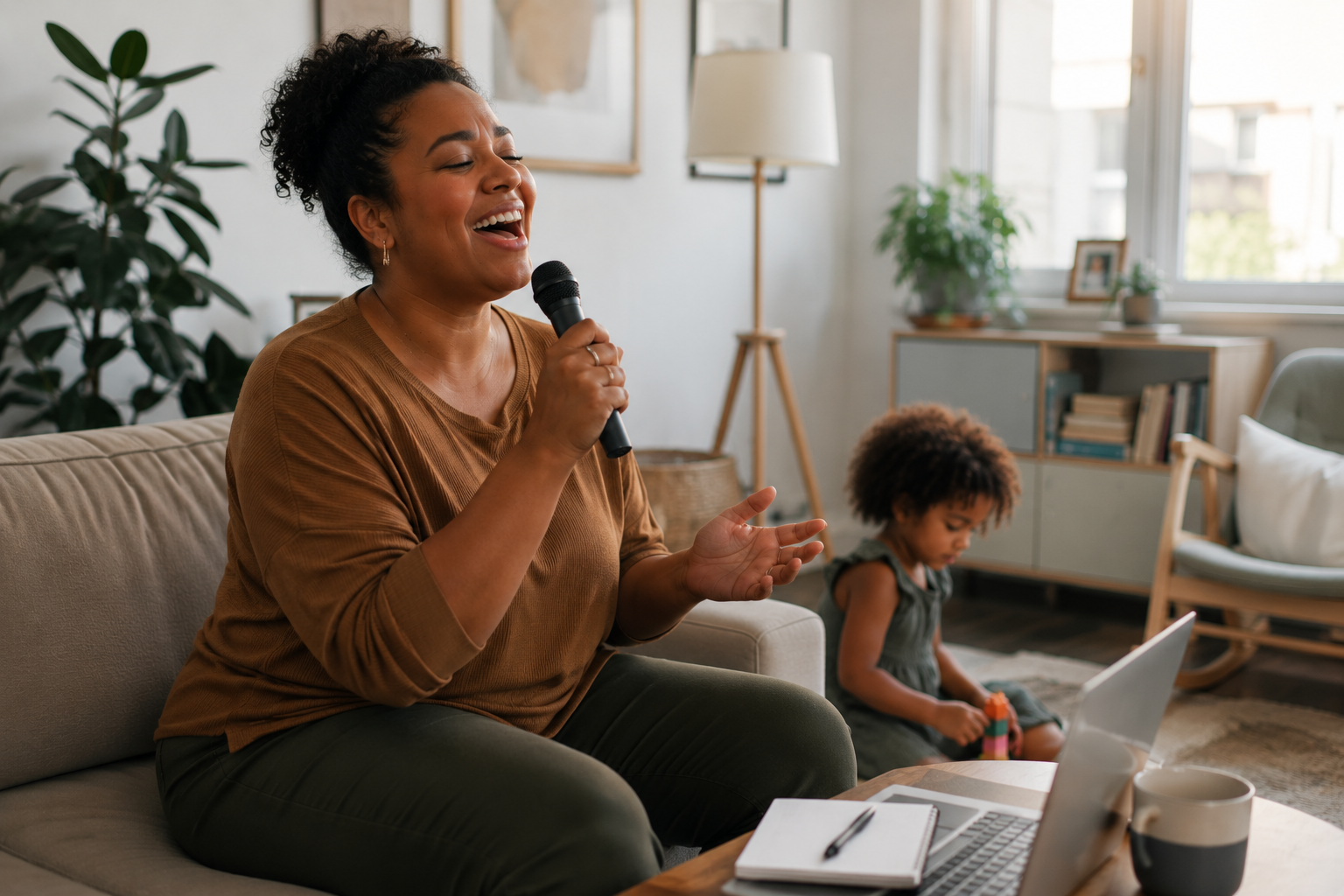
To start singing again after kids, give yourself four weeks of five-minute sessions, not four hours of guilt. Week one is breath. Week two is gentle warm-ups in the margins of your day. Week three is one song you used to love. Week four is the practice rhythm that actually fits your life.
If you're reading this with one ear tuned to the baby monitor, or you just realized the loudest you've sung this year was "Wheels on the Bus" at a stoplight — you are exactly the person I wrote this for.
I work with moms every week who used to sing. In choirs. In bands. In bedrooms with the door shut. Then somewhere between sleepless nights, sippy cups, and the everything-else of motherhood, the singing got quiet. Maybe it stopped. And now they want it back, but they don't know where to start — and they're a little afraid of what they'll sound like when they try.
Here's the truth I tell every one of them: your voice didn't leave. It's just been waiting. And four weeks of small, kind practice is enough to find it again.
Why does it feel so much harder to start singing again after having kids?
It feels harder because three things are usually true at once. First, your body has changed — pregnancy, birth, breastfeeding, sleep loss, and the chronic low-grade tension of running a household all change how you breathe, how your ribs move, and how much spare energy your nervous system has for anything that isn't keeping small humans alive.
Second, your time has changed. You used to have 45-minute practice windows. Now you have an eight-minute gap between snack and meltdown. The old practice plan doesn't fit, and "I don't have time" becomes the easy place to land.
Third, and this is the one nobody warns you about — your identity has shifted. "Mom" took up so much room that "singer" got squeezed into a smaller and smaller corner. Going back to singing isn't just a vocal project. It's a quiet act of remembering who else you are. That's why it feels heavy, and why it matters so much.
The plan below is built around all three. It assumes your time is short, your body is tired, and your inner critic has had three years of unchallenged airtime.
How to start singing again after kids: a 4-week plan
Each week below takes five minutes a day, four to five days a week. That's it. If you do more, beautiful. If you do less, that still counts. Consistency beats intensity every time, especially when you're rebuilding.
Week 1 — Just breathe like a singer again
Before you sing a single note, you re-teach your body to breathe low. Lie on your back on the floor (the bed will do — but the floor is firmer feedback). Put one hand on your belly, one on your chest. Breathe in through your nose for four counts and let your belly rise, not your chest. Exhale slowly through pursed lips for six counts.
Do ten of these. That's your whole practice for Week 1. Five minutes, lying down, no sound required. You're not being lazy — you're rebuilding the foundation that everything else stacks on top of. Most returning singers have been chest-breathing for years.
Bonus version: do it while the baby naps on your chest. The weight is a built-in biofeedback tool.
Week 2 — Warm-ups in the margins
This week you make sound. Five minutes a day, anywhere you can grab them — in the car after school drop-off, in the shower, in the kitchen while the kettle boils.
The routine:
Lip trills (30 seconds): blow air through gently closed lips so they buzz, like a horse exhale. Glide up and down a small comfortable range.
Sirens on "ng" (1 minute): like the last sound in "sing," but held. Slide from your lowest comfortable note to your highest comfortable note and back, like a slow siren. No pushing — just gliding.
5-note scales on "mah" (2 minutes): pick a comfortable starting note. Sing "mah-mah-mah-mah-mah" up five notes and back down. Move up one semitone. Repeat until it gets effortful — then stop. That's your top for today.
One descending sigh on "ah" (30 seconds): start high, sigh down. Let it be loose and a little dramatic. This is the "release" rep.
30 seconds of humming any tune — happy birthday, a hymn, a lullaby, whatever's in your head. Just hum it, lightly.
That's it. Five minutes. Don't extend it. The point is making singing a thing that happens every day, not a thing you save up for. FYI, The Vocal Refresh app has a built-in habit tracker.
Week 3 — One song you used to love
This is the week the joy returns. Pick one song from before. Not a hard one. Not the audition piece. The song you used to sing in your car when you were twenty-two and the world was wide open. Or the one you sang in choir that always made your throat go tight in a good way.
Warm up for two minutes (Week 2 routine, abbreviated). Then sing the song. Once. Maybe twice. Don't record yourself yet. Don't analyze it. Just sing it like nobody's listening — because honestly, between the dishwasher and the dryer, nobody is.
You'll probably notice three things: (1) some notes are easier than you expected, (2) some notes are harder than you remember, and (3) it felt better in your body than you anticipated. All three are normal. None of them are emergencies.
If you feel anything sharp, scratchy, or strained — stop. That's the inner critic, or the dehydration, or both. Drink water and try again tomorrow.
Week 4 — Practice like a mom, not like you're twenty-two
This is the week the practice becomes yours — designed for your life, not for the practice schedule you had before you were responsible for another human being.
By the end of Week 4 you should have a rhythm that looks something like this:
3 days a week: five-minute warm-ups (Week 2 routine).
1 day a week: ten minutes of "real" singing — warm up, then one to two songs.
1 day a week: rest. Yes, rest is part of the plan. Your voice repairs while you sleep and while you don't sing.
You can run this plan with nothing but your phone, but a guided app makes the daily five minutes easier to actually keep. If you want one, here's the app I'd start with and how it stacks up against the others for women coming back to singing.
That's seven hours a year of practice. Less than half a Netflix series. And it is genuinely enough to bring a voice back if you do it consistently. The moms I coach who follow this rhythm for ninety days are usually startled at how much they've recovered.
What if my voice sounds worse than I remember?
It probably does, in some ways, and it doesn't, in others — and that's okay. Most returning singers report three changes: a slightly lower comfortable range, a small loss in stamina, and a tone that's a little breathier than it used to be. All three are very fixable. They're not damage. They're the predictable shape of a voice that hasn't been asked to do much for a while.
One thing that often happens: your voice has actually matured. Many women report that their post-thirty voice has warmth, depth, and emotional access their twenty-two-year-old voice couldn't touch. The technique needs reawakening; the soul has only gained.
If you'd like a deeper read on this exact emotional terrain — the "I don't recognize my voice anymore" feeling — I wrote a longer piece on it: to Rediscover Your Singing Voice.
How long until I sound like myself again?
For most moms following the five-minutes-a-day plan above: small wins in two to three weeks, a noticeable difference in six to eight weeks, and a real "oh — there I am" moment somewhere around the three-month mark. If you've had a long break (five years or more), give it five to six months for full recovery of stamina and high notes.
Three accelerators worth knowing about:
Hydration. Boring, free, more powerful than any exercise. The vocal folds need to be wet to vibrate cleanly. Aim for water you can sip throughout the day, not chugged in big glasses.
Sleep. Yes, I know. But even thirty extra minutes makes a measurable difference in vocal tone.
Daily-ness. Five minutes every day beats fifty minutes on Sunday every time. The vocal folds respond to consistency, not heroics.
What if the kids walk in halfway through my warm-up?
Let them. In fact — invite them. Some of my favorite warm-up routines started as "Mommy, what's that noise?" and turned into shared lip-trill races and family siren contests. Kids who see their mom singing learn that singing is a thing grown-ups do, not just something on a stage or in a screen. That's a gift to them and a permission slip to you.
If you'd rather have a few minutes that are genuinely just yours, a closed bathroom door and a running tap covers a lot of "mah-mah-mah-mah-mah." Don't underestimate the bathroom as a practice space — the tile is great for confidence.
What if I haven't sung since the kids were born and that's been a long time?
Then start exactly here, exactly with Week 1. The plan does not care whether your break was two years or twenty. The body responds to the same gentle inputs either way. The only thing a longer break adds is a slightly longer ramp — give yourself the full four weeks before you judge anything, and the full ninety days before you decide what your voice can or can't do.
And — gently — you might find the inner critic is louder than the technique gap. That's worth its own work. I wrote about that here: How to Find Your Singing Voice Again as an Adult.
Frequently Asked Questions
Can I really get my singing voice back after kids?
Yes. Voices are remarkably resilient. Unless there's a specific medical issue (nodules, reflux damage, persistent hoarseness — all worth checking with an ENT), the muscle memory and range that you had before kids are mostly recoverable. Most returning moms regain 80–90% of their previous capacity within three to six months of consistent gentle practice. The remaining 10–20% is often replaced by something better: a more mature, emotionally connected tone.
How do I practice singing with kids around the house?
Stack practice onto things you already do. Lip trills while you load the dishwasher. Sirens in the car at school pickup. Five-note scales while the bath fills. The car is genuinely the best practice studio most moms have access to — soundproof, private, and you're already in it. The kids think you're having fun, which is the correct reaction.
What if I'm afraid I'll sound bad?
You probably will, a little, for the first week or two. That's not a flaw — that's information. Every singer who has ever returned from a break has sounded worse for a stretch before sounding better. The fear of sounding bad is what kept you from starting; the only way out is through. Start in a private space, don't record yourself yet, and trust that week three feels different than week one.
Do I need a voice teacher to start singing again, or can I do it alone?
You can absolutely start alone — the four-week plan above is designed for exactly that. A teacher (or a well-built app) becomes useful around week six or eight, once you have a baseline and specific questions: "Why does my voice crack here?" "How do I extend my range?" "What's the right way to belt without straining?" Until then, your job is just to show up daily.
How often should a mom practice singing?
Five minutes a day, four to five days a week, with one rest day. This is the floor that produces the most reliable results for moms with full schedules. You can go longer when you have time, but you can't go less often and expect the voice to come back. Consistency is the lever. Heroic Sunday sessions are not.
What's the best time of day to practice singing as a mom?
Mid-morning to early afternoon is technically optimal — the vocal folds are hydrated and warmed up from talking, but not fatigued. Practically, the best time is the time you'll actually do it. For many moms that's right after school drop-off, during a baby's nap, or in the car between errands. The "perfect" time you never use is worse than the imperfect time you actually use.
Is it too late to start singing again if I'm in my 40s or 50s?
No — and the data is genuinely on your side here. Voice teachers and ENTs broadly agree that a well-cared-for adult voice can develop and improve well into the 60s and beyond. What changes with age is recovery time and stamina, not capacity. Many of the best singing students I work with are in their 40s and 50s and bring an emotional depth that younger singers haven't lived into yet.
Keep reading
Rediscover Your Singing Voice — the emotional companion piece to this one.
How to Find Your Singing Voice Again as an Adult — when the inner critic is louder than the technique.
Vocal Refresh — the five-minute daily warm-up app this routine eventually graduates into.