The Best Vocal Training Apps for Moms (Returning to Singing) — 2026 Edition
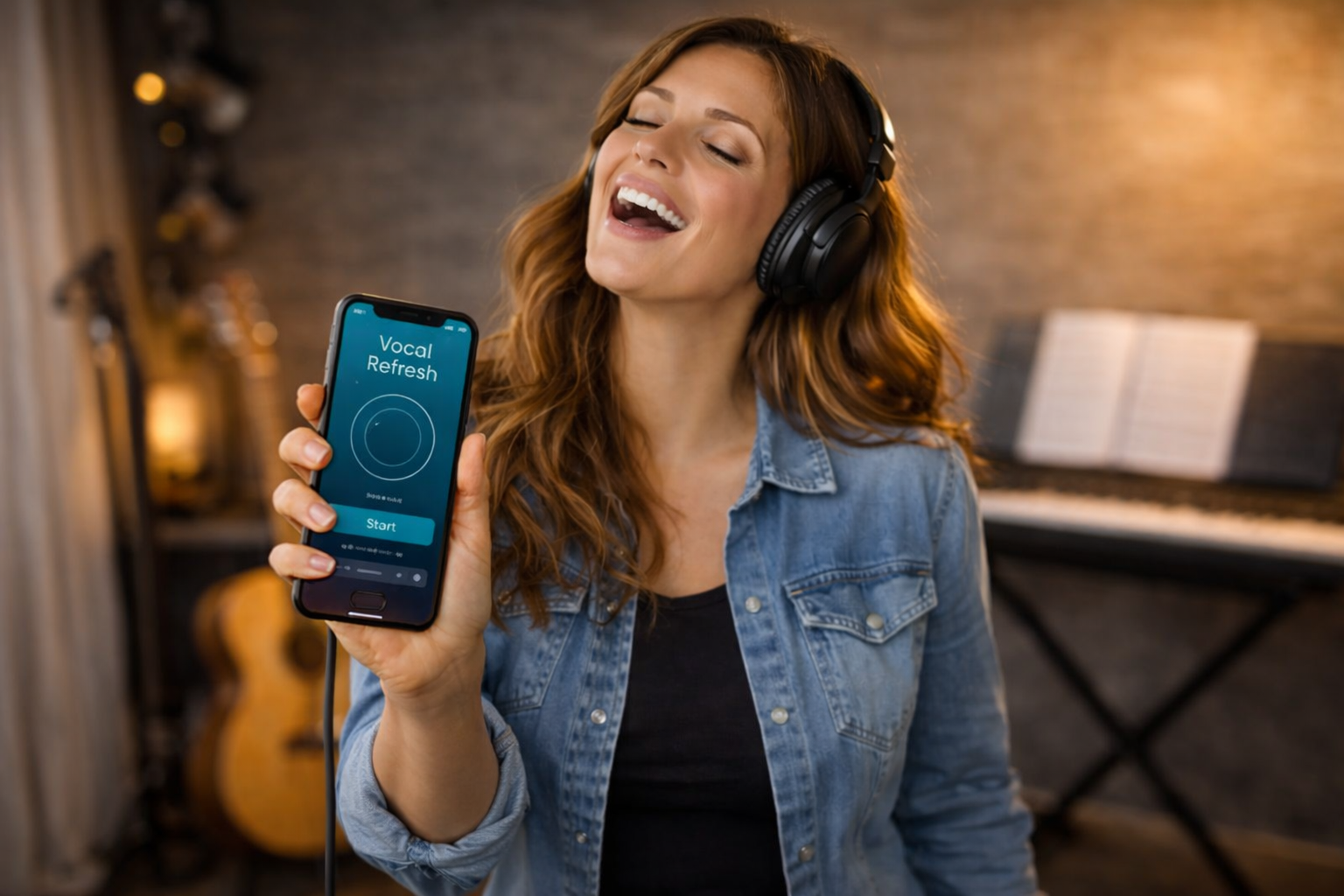
The best vocal training app for moms returning to singing is one that fits in five minutes, doesn't require recording yourself out loud, and meets you at the range you actually have today. Our 2026 pick: Vocal Refresh. Runners-up: Sing Sharp, SongTorch, Yousician, Smule.
👉 Skip to the verdict: If you have five minutes, a phone, and a kid likely to interrupt, start with Vocal Refresh — it's the app I built specifically for moms returning to singing. Free to try, no recording required, no judgment.
Most "best singing app" roundups are written by people who don't sing and reviewed by editors who don't either. This one is different: I'm Ingrid Moss, a vocal coach, and I've spent the last six months testing every singing app I could install — specifically through the lens of the women I actually teach. They're moms. They have five minutes. They are not auditioning for The Voice. They want to sound like themselves again.
Here's the honest ranking, plus which app is right for which kind of returner.
Best vocal training apps for moms — 2026 ranking at a glance
Vocal Refresh — Best for returning singers. 5-minute sessions. No recording required. Full free tier. Mom-friendly: ⭐⭐⭐⭐⭐
Sing Sharp — Best for pitch training and ear development. 10–15 minute sessions. Requires recording. Limited free tier. Mom-friendly: ⭐⭐⭐
SongTorch — Best for learning specific songs by ear. 15–25 minute sessions. Recording optional. Limited free tier. Mom-friendly: ⭐⭐⭐
Yousician — Best for game-style structured lessons. 10–20 minute sessions. Requires recording. 7-day trial only. Mom-friendly: ⭐⭐
Smule — Best for karaoke and community. 3–5 minute songs. Recording is the product. Free tier with ads. Mom-friendly: ⭐⭐
"Mom-friendly" = quiet by default, doesn't demand a recording, can be paused mid-exercise without losing your spot, runs in five minutes.
1. Vocal Refresh — best for moms returning to singing
Vocal Refresh is the app I built after years of coaching women back into their voices and watching them quietly uninstall every other singing app within a week. The whole thing runs on five-minute routines: pick where your voice is today (rusty / a little warmed up / ready), hit play, and you're singing before the kettle's boiled. There's no microphone analysis, no "you sang a B flat instead of a B" guilt trip — because beginners don't need that, they need to start.
Use it if: you used to sing, you have five minutes between things, and you want to feel your voice come back without being graded.
Skip it if: you're an advanced singer prepping for an audition (this isn't the tool for you, and that's fine).
Price: free to try, currently in waitlist mode while we onboard founding users. Join the waitlist →
2. Sing Sharp — best for pitch training
Sing Sharp's pitch-visualizer is one of the better ones on the market. If you're not sure whether you're hitting the right notes, this app will tell you with a live waveform. The catch: it asks you to sing into a microphone almost constantly, which is fine if you have a quiet room and don't mind hearing yourself back. For moms in a house with kids, it's a harder sell.
Use it if: you're working on ear-training specifically and have a quiet 15-minute window.
3. SongTorch — best for learning specific songs
SongTorch slows songs down, isolates parts, and lets you sing along to a stripped-down backing track. Excellent if there's a specific song you've been wanting to sing for years. Not really a "vocal training" app in the technique sense — it's more a learning-by-doing app.
4. Yousician — best for structured lessons
Yousician has the gamified-lesson model down. The vocal track is solid, the progression is clear, and if you like the dopamine of a streak counter, it works. The downside is the same as Sing Sharp: it relies on hearing you sing, and the "you got it wrong" feedback can put returners off in their first week.
5. Smule — best for karaoke community
Smule isn't really a training app — it's karaoke with social features. But it earns a spot here because for some women, the thing they actually need is permission to make sound with other adults. If that's you, Smule is the lowest-pressure way to do that without leaving the house.
Before you download anything…
Grab the free Vocal Habit Tracker — a one-page sheet that turns whichever app you pick into a five-minute daily habit you'll actually keep. Lives on the fridge or in your phone. Get the free Habit Tracker →
How I picked these (and what to look for in any singing app)
Six months, every paid plan, side-by-side. The four criteria that mattered for the audience I work with:
1. Five-minute fit. Anything requiring a 30-minute uninterrupted block does not survive contact with a household. Sessions need to be pausable.
2. Recording-optional. Asking returning singers to hear themselves back in week one is a fast way to make them quit. The best apps build confidence first, audio analysis later.
3. Range-appropriate. Apps that pitch every exercise in a 22-year-old's range are not going to work for a 38-year-old who hasn't sung since high school. The good ones meet you at your speaking pitch.
4. Tone. No "you failed this exercise" language. Returning singers have already absorbed a lifetime of that.
Already picked an app? These pair well:
How to Start Singing Again After Kids: A Mom's Gentle 4-Week Plan — the week-by-week plan to pair with whichever app you pick.
Five-Minute Vocal Warmups for Busy Moms — the routine you'll run inside any of these apps.
Vocal Refresh — the daily 5-minute app built for moms.
Frequently Asked Questions
Are there free vocal training apps that actually work?
Yes — Vocal Refresh's full free tier and Smule's ad-supported free tier are the two best free entry points in 2026. Sing Sharp's free tier is limited but its pitch visualizer is usable. The "free trial then $$$" apps (Yousician, some of the larger brand apps) don't really count as free for our purposes — you'll hit the paywall in a week.
What's the best singing app for beginners over 40?
Vocal Refresh. It was designed for returning singers — most of whom are over 40 — and skips the "you missed that note" feedback that puts beginners off. Sing Sharp is a strong runner-up if you specifically want pitch training and don't mind the recording-heavy workflow.
Can a singing app replace a vocal coach?
For the first six months of getting your voice back? Probably yes. For deeper work — repertoire choices, dealing with a specific vocal habit, recovery from a vocal injury — no app substitutes for a one-on-one coach. Most of the moms I work with use an app daily and book a live lesson every four to six weeks.
Do I need a microphone or special equipment?
Your phone's built-in mic is fine for any of these apps. Apps that require recording (Smule, Yousician, Sing Sharp) work better with a $20 lavalier mic if you're serious, but it's not required to start. Vocal Refresh doesn't ask you to record at all, so you can run it on a six-year-old phone in your kitchen and be fine.
Which singing app is best for someone who hasn't sung in years?
Vocal Refresh — it's specifically designed for the "I used to sing but stopped" returner. The routines start gentle, the range adjusts to wherever your voice is on a given day, and nothing in the app gives you the feeling of being graded.
Are AI vocal coach apps worth it in 2026?
The AI vocal coach apps available in 2026 are good at pitch analysis and rhythm tracking, and getting better at tone description. They're not yet good at the human stuff — confidence, identity, "why does this feel hard." For moms returning to singing, the human stuff is most of the work, so the AI features are a nice-to-have, not a must-have.
Ready to actually do the thing?
Vocal Refresh is the daily 5-minute warm-up app I built for moms returning to singing. Pick where you are, hit play, and you're singing before the kettle's boiled. Try Vocal Refresh free →