Head Voice vs. Chest Voice, Explained for Moms Who’ve Never Had a Lesson
New here?Vocal Refresh is the 5-minute daily warm-up app I built for moms coming back to singing — it walks you through finding both of these voices, gently, no reading music required. Try it free →
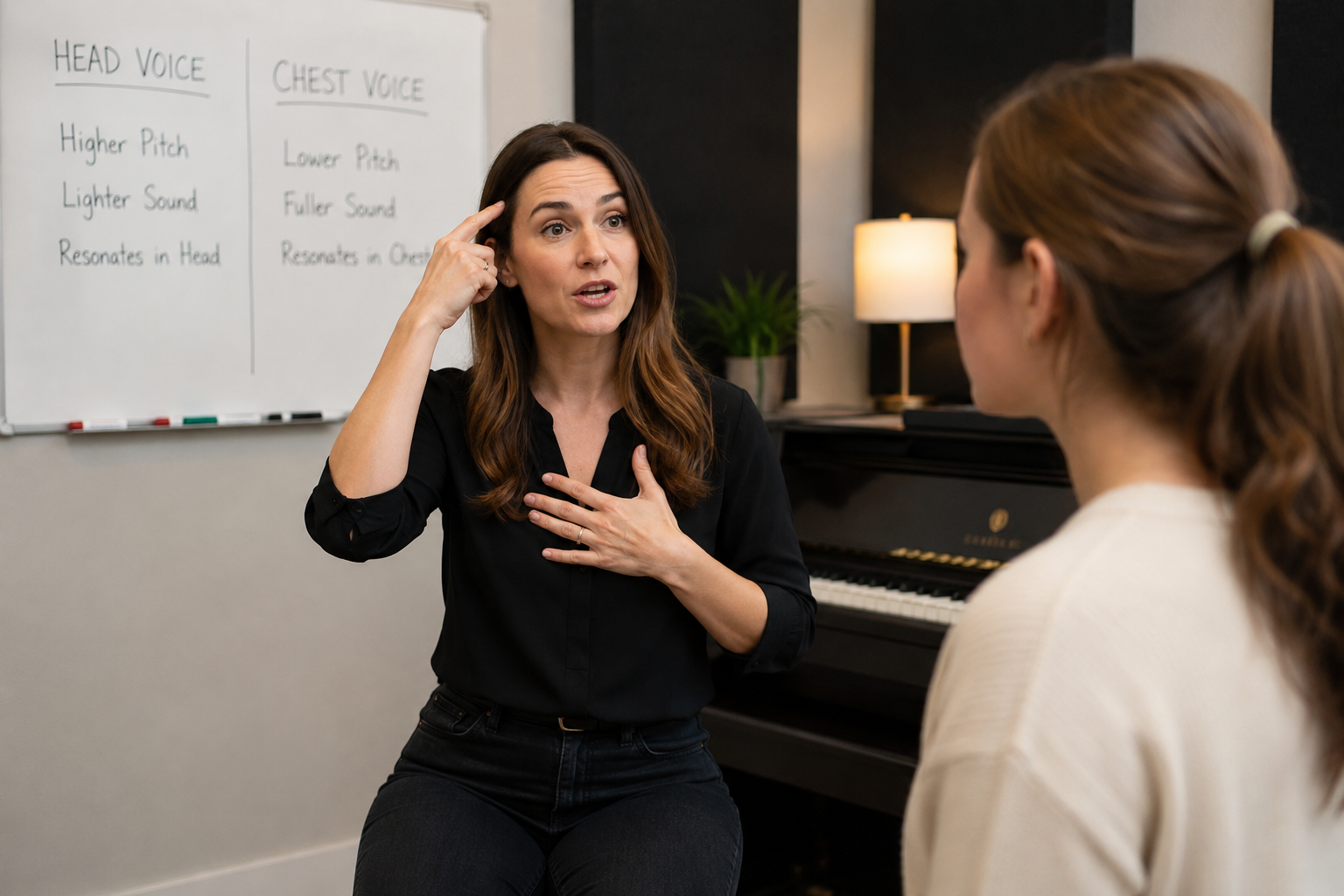
Chest voice is the lower, fuller sound you use when you talk and when you belt along to the radio — you can feel it buzz in your chest. Head voice is the lighter, higher sound that seems to ring up behind your eyes and the top of your head. They're not two different voices. They're two ways your one voice naturally works.
If you've ever watched a singing video where someone said "now switch to your head voice" and quietly thought I have no idea what that means and I'm not about to admit it — you are in exactly the right place. You don't need to read music. You don't need to know what a register is. You're a mom who used to sing, or always wanted to, and you'd just like the words people throw around to actually mean something.
So let's do this the way I'd do it standing in your kitchen, not in a conservatory. By the end you'll have felt both of these voices in your own body — probably while the kettle's still warming up.
What is chest voice?
Chest voice is your everyday voice. It's the sound you make when you say "MORNING, who needs breakfast?" — low, full, and grounded. The name comes from a simple thing: if you put your hand flat on your breastbone and say a low "uh-huh," you'll feel a buzz under your palm. That vibration is why it's called chest voice.
It's the voice you reach for when you sing the verse of a song, when you hum along in the car, when you belt the chorus a little too enthusiastically at a wedding. It feels strong and familiar because it is familiar — it's the same voice you've been talking with your whole life.
What is head voice?
Head voice is the higher, lighter sound that feels like it resonates up high — behind your eyes, around your forehead, the top of your head. If chest voice is a mug of tea sitting solidly on the table, head voice is the steam rising off the top of it.
You already use it, even if no one ever named it for you. When you go "wheee!" lifting a toddler in the air, when you call "coo-eee!" up the stairs, when you do the high silly voice reading a bedtime story — that's head voice. It can feel thinner or less powerful than chest voice at first, especially if you haven't used it for singing in years. That's normal. It's not weak; it's just untrained.
How can I feel the difference between head voice and chest voice right now?
Here's the five-minute version. You don't need to be "good" at this — you just need to notice where the buzz goes.
Step 1 — Find chest voice. Put a hand on your breastbone. In a comfortable, low speaking pitch, say "one, two, three" like you mean it. Feel the vibration under your hand. That's chest voice. Now sing a low, easy "ah" on the same pitch and keep that same chesty, grounded feeling.
Step 2 — Find head voice. Move your hand to the top of your head. Make a gentle, high "ooo" like a soft ghost — ooooo — up where calling "coo-eee!" lives. It'll feel lighter, maybe a little breathy. The buzz moves up and out of your chest. That's head voice.
Step 3 — Slide between them. On an "ooo" or a "wee," start low and let your voice float up high, like a slow siren or a cartoon "wheee." Somewhere in the middle you'll feel the sound hand off from chesty-and-full to light-and-ringing. That handoff is the whole thing. That's all "switching registers" means.
Want a place to actually keep this up?
I made a free Vocal Habit Tracker for exactly this — a simple, no-pressure way to do five minutes a day and watch the streak build instead of disappearing into the laundry pile. Grab the free tracker →
Why does my voice "crack" or "break" in the middle?
That wobbly, slightly alarming flip in the middle of your range has a name: it's the passaggio — Italian for "passage," the bridge between chest and head voice. The crack happens when your voice can't decide which gear to be in, a bit like a car lurching between second and third.
It is not a sign you can't sing. Every single voice has this bridge — opera singers, your favourite pop star, the person who sounds incredible at karaoke. The difference is they've practised crossing it smoothly. The crack gets smaller with gentle, repeated trips through that middle on easy sounds (sirens, lip trills, soft "ooo" slides). You don't force your way through it. You coax. If a tight, pushed feeling is creeping in when you reach for higher notes, that's worth its own read — I wrote a whole gentle fix-it guide on how to sing without sounding strained.
What is "mixed voice" and do I need to worry about it?
Mixed voice is exactly what it sounds like: a blend that borrows the fullness of chest voice and the ease of head voice at the same time. It's what lets singers carry a strong, connected sound up high without either belting until it hurts or going wispy and thin. It's the smooth middle gear.
Here's my honest advice as a coach who works with moms returning to singing: you do not need to think about mixed voice yet. It tends to show up on its own once you've spent a little time getting comfortable moving between chest and head without forcing. Chasing "mix" too early is the singing equivalent of trying to parallel park before you've found the accelerator. Find your two voices first. The blend follows.
Is head voice the same as falsetto?
People use these words loosely, so here's the plain version. Falsetto is a particularly light, airy, somewhat hollow version of the upper voice — think of a breathy, disconnected high sound. Head voice, when it's developed, is fuller and more connected than falsetto while still living up in that higher, ringing space. For where you are right now, you really don't need to police the line between them. If you can make a light high sound at all, you've got something real to build on — and naming it perfectly matters far less than using it regularly.
Which voice should a returning singer practise?
Both — but most moms I work with have a strong, comfortable chest voice (years of talking, and often years of singing to babies) and a head voice that's gone shy from disuse. So if you only have five minutes, spend a little extra time up high: gentle sirens, soft "ooo" slides, the calling-up-the-stairs sound. You're not trying to be loud or impressive. You're reminding your voice that the upstairs rooms still exist. Pair that with the easy return-to-singing routine in how to start singing again after kids and you've got a real, gentle practice — no lessons, no theory, no audience required.
The two-minute recap
Chest voice = lower, fuller, buzzes in your chest, the voice you talk with. Head voice = higher, lighter, rings up top, the voice you call "coo-eee!" with. The crack in the middle is the bridge between them, and it smooths out with gentle practice, not force. Mixed voice is the blend, and it'll come later on its own. That's genuinely the whole map. You don't need more theory than that to start singing today.
Frequently Asked Questions
What is the difference between head voice and chest voice?
Chest voice is the lower, fuller sound you use for talking and belting — it vibrates in your chest. Head voice is the higher, lighter sound that resonates up around your forehead and the top of your head. They're two natural ways your single voice works, not two separate voices, and most people use both every day without realising it.
How do I find my head voice as a beginner?
Make a gentle, high "ooo" like a soft ghost, or imitate calling "coo-eee!" up the stairs. Put a hand on the top of your head and notice the lighter, ringing feeling up high rather than a buzz in your chest. Start with quiet, easy sounds — head voice strengthens with regular, relaxed use, not by pushing for volume.
Why does my voice crack between chest and head voice?
The crack happens at the passaggio, the natural bridge between your two registers, when your voice hesitates between gears. Every voice has it, including professionals. It isn't a sign you can't sing — it smooths out gradually with gentle exercises like sirens and lip trills that carry you across the middle of your range without forcing.
Is head voice the same as falsetto?
Not quite. Falsetto is a lighter, airier, more disconnected version of the upper voice. Developed head voice is fuller and more connected while still ringing up high. For a returning singer the distinction barely matters at first — being able to make and use a light high sound is what counts; the precise label can wait.
Do I need mixed voice to sing well?
Eventually a blend of the two registers helps you sing high notes with strength and ease, but you don't need to think about mixed voice when you're starting out. It tends to develop naturally once you're comfortable moving between chest and head voice. Build those two first; the blend follows on its own.
Can I learn head voice and chest voice as an adult with no lessons?
Absolutely. Both registers are part of every healthy voice, and you already use them in everyday life. Five gentle minutes a day — sliding between a low "ah" and a high "ooo" — is enough to start reconnecting them. A guided warm-up app like Vocal Refresh, or a simple daily habit tracker, makes it easy to keep going without formal lessons.
Ready to actually do the thing?
Vocal Refresh is the daily 5-minute warm-up app I built for moms returning to singing. It walks you through finding both your chest and head voice — gently, no reading music, before the kettle's boiled. Try Vocal Refresh free →